
Time stand still.
Two thrilling concerts in the rear view, and two thrilling concerts ahead that I can't attend—but you should.

This most anomalous year has held true to form over the past long months, preventing my finding the time to write here, or to have much to say, really. But I’ve managed to get out twice to hear music performed live since last I filed a concert update—and believe me, friends, that’s something.
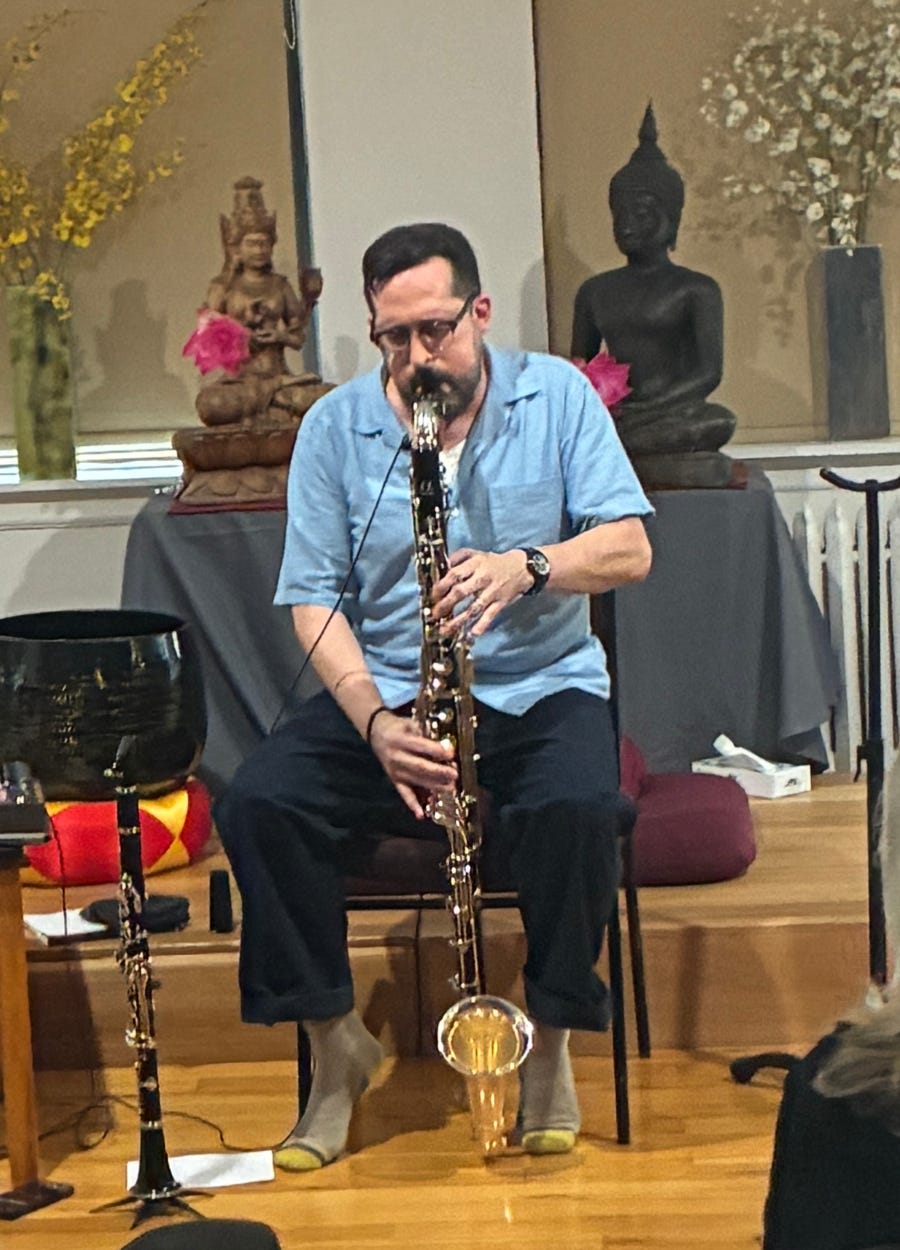
The first outing was the performance by Jeremiah Cymerman that I wrote about here on July 17: a brief but impactful set of electronically enhanced solo pieces for clarinet and bass clarinet at New York Insight Meditation Center. Preceded by a guided meditation by Anjie Cho, the concert offered sonic spaces in which to linger for a time in stillness and contemplation.
If I half-expected some some sepulchral riff on Tony Scott’s trailblazing 1965 LP, Music for Zen Meditation and Other Joys, what I experienced was more profoundly informed by John Coltrane’s ceaseless quest, Eric Dolphy’s sonic explorations, and Pauline Oliveros’s Deep Listening discipline.
Blessed with a keen ear for detail, Cymerman treated his horn with feedback, distortion, echo, and other interventions that altered his sound and the space around it. He’d billed the performance as his first since making the bass clarinet his chief horn, but owing to circumstance began the evening on a standard B-flat horn, pliant bends and slurs evoking klezmer balladry. His second piece transposed that expressive vocabulary downward, bass clarinet tones augmented with roseate aura and burbling electronic counterpoint.
Explaining to his listeners that he doesn’t consider himself a jazz musician, Cymerman nevertheless continued with Coltrane: “Love,” from the 1966 LP Meditations – appropriate! – with ghostly pulsations and iridescent chorales etching paths through the air around his warbling low horn. One final soliloquy included electronically generated accompaniment, sounding at times like an invisible accordion.
It was clear from the start that most of the small audience came from the meditation center’s core clientele rather than the new-music community, so it was gratifying to see listeners paying rapt attention, and posing thoughtful, curious questions after it ended. For me, the experience was exactly the right input in the right setting at the right time, and I eagerly anticipate following Cymerman on this new journey.
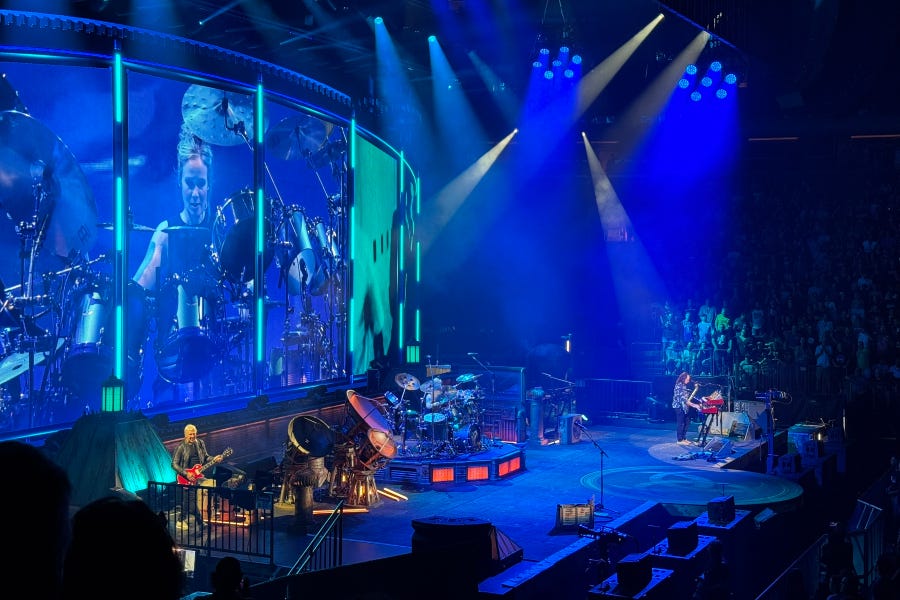
The other show I saw, thanks to my esteemed friend and colleague Hank Shteamer, was something else entirely: Geddy Lee and Alex Lifeson celebrating 50 years of Rush at Madison Square Garden, an unapologetic nerd-rock apotheosis in which we all were Paul Rudd and Jason Segal.
Taking on the almost unthinkable challenge of filling in for the late Neil Peart, drummer Anika Nilles was miraculous: locked in tight, sufficiently faithful to Peart to make 20,000 fans roar with every rippling tom-tom barrage, and willing to add her own flourishes when it was appropriate. (That she’s also locked into the band’s screwball humor was clear in the way she finished the evening’s last song, “Working Man.”) The power trio also benefited from the added hands and pipes of keyboardist Loren Gold, who freed Lee up to roam and leap more freely than in most recent tours.
The setlist on August 1 was the third in a four-set rotation Rush has carried from coast to coast, the one incorporating the entire Moving Pictures LP from start to finish. That was exciting, but my highlights lay elsewhere: “La Villa Strangiato,” a display of peacock virtuosity so gleeful that I misted up in shared delight; and “Time Stand Still,” a potent reflection on time, loss, and what we carry with us, sublime even when Aimee Mann’s part is phoned in.
When tears came, I didn’t even try to hold them back.
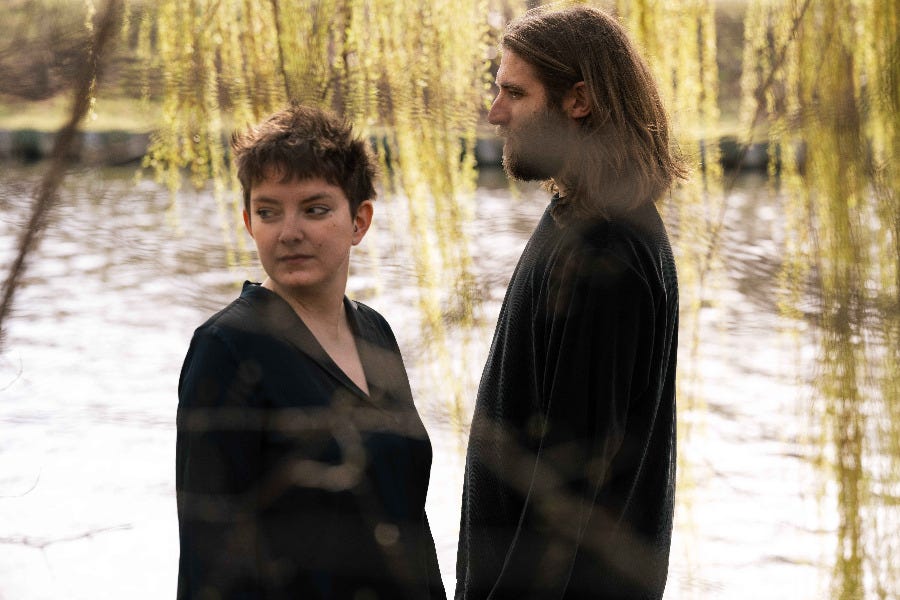
Getting back to my old pace with listings is still going to take some time, and I’m doing my best to be patient with myself. But there’s no way I can let this week go by without mentioning the supremely fine violinist Sarah Saviet is here in town for two performances during this year’s action-packed Time:Spans festival, which opened last Saturday. I won’t be able to attend either of them, so I’m counting on you to get there and tell me what I missed.
I wrote about Saviet for Musical America in March 2024, covering her as New Artist of the Month. (Unlike most MA content, this piece is not paywalled.) The article discusses Saviet’s journey from childhood in Washington, D.C., through training at Peabody Preparatory and Indiana University to arrive in Berlin, where her career as a new-music advocate has blossomed.
Saviet spoke with me about who and what prompted her to pursue her chosen path. And composers Bryn Harrison and Liza Lim weighed in on working with Saviet.
“One thing I love about how Sarah plays is the way she follows the violin right inside the sound, so you feel like you’ve got access to the inner voice of the instrument, of the music and of Sarah herself. It’s this ‘secret voice’ that I’m always keeping an ear out for as a composer – a feeling of alignment that shows up as a kind of truth-telling in art.”—Liza Lim
Saviet’s first Time:Spans appearance comes this Friday, Aug. 14, when she and baritone Ty Bouque participate in the world premiere of O Maria by Kelley Sheehan, an award-winning composer and sound artist, in a concert also featuring GrauSchumacher Piano Duo and SWR Experimentalstudio. (These soloists share what might be an unsuspected connection: in 2024, Bouque profiled Saviet for the contemporary-music webzine VAN.)
The second concert, on Sunday, Aug, 16, brings together Saviet and her frequent platform partner, pianist-composer Joseph Houston, for the U.S. premiere of The Blue Hour by Sarah Hennies. A 90-minute exercise in patience, focus, endurance, and intensity, the piece had its premiere at Donaueschinger Musiktage last October, and was repeated in November at the Huddersfield Contemporary Music Festival.
From the Huddersfield program notes:
For Hennies, repetition is never only a musical device. As she writes, “my work for the past nearly 20 years has been based primarily on repetition and often exploring the ways in which repetition affects my life in other, non-musical ways.” In The Blue Hour, those repetitions take on the qualities of her recurring dreams: vivid and often unsettling states of being chased, unable to reach a destination, or caught in cycles that never resolve. The music too feels “unfulfilled, never reaching a resolution or destination,” drawing the listener into a fragile, suspended terrain.
You can read a more personal program essay by Hennies on the Time: Spans website. The Blue Hour is an extraordinary piece: deeply personal, sonically resourceful, stylistically illimitable. Happily it’s being recorded this weekend for those of us who can’t be there. But if you can attend, you should.
Time:Spans 2026 runs through Saturday, Aug. 22 at the DiMenna Center for Classical Music, 450 W. 37th St., midtown west; timespans.org
NYC event calendars.
By music lovers, for music lovers.
All Ears – classical, experimental & creative musics; monthly
Concert Net – indie-rock & eclectic; weekly
Dada Strain – creative & club musics, activism & community; weekly
Extended Techniques – experimental & creative musics; monthly
GUNKYARD – indie rock, punk & underground; monthly
Lament for a Straight Line – “Must See Three” jazz; weekly
New Music Calendar – contemporary concert music; continuous
ODEA – classical & experimental music; monthly
Love this. Is it possible to hear these shows or similar?